
By Dr. Pamela Frank, BSc(Hons), ND – Published July 2026
Few things are more dismissive to someone struggling to conceive than being told to “just relax” or “it’s just stress.” While stress affects fertility, it implies that stress is the cause of their infertility and that relaxation is the cure – neither of which is accurate, and both of which add guilt to an already difficult experience.
The actual relationship between stress and fertility is more specific, more mechanistic, and more clinically actionable than “relax and it’ll happen.” Chronic activation of the stress response does interfere with reproductive hormone signalling through identifiable, well-characterized pathways. Those pathways are worth understanding – not so you can feel responsible for your infertility, but so you can address the physiological effects of chronic stress as one modifiable variable among many, with the same systematic approach that I would use for every other modifiable factor.
This post explains the specific mechanisms. It also explains what the evidence does and does not support about how stress affects fertility, and what actually helps.
The Stress Response: A Brief Biology Refresher
When the brain perceives a threat – whether physical danger, a work deadline, financial pressure, relationship conflict, or the monthly anxiety of a two-week wait after ovulation or an embryo transfer – the hypothalamus activates the stress response through two parallel pathways:
The fast pathway: sympathoadrenal system. The hypothalamus signals the adrenal medulla to release adrenaline (epinephrine) and noradrenaline (norepinephrine) within seconds. Your heart rate rises, your blood flow is redirected to your muscles and your brain, and non-essential functions (including digestion and reproduction) are acutely suppressed. This response is designed for short-term threats and resolves quickly once the threat passes.
The slow pathway: HPA axis. Simultaneously, the hypothalamus releases corticotropin-releasing hormone (CRH), which signals the pituitary to release adrenocorticotropic hormone (ACTH), which signals the adrenal cortex to produce cortisol. Cortisol rises over 15-30 minutes, peaks, and then, in a healthy stress response, is cleared within a few hours as the negative feedback loop suppresses further CRH and ACTH release.
The problem is chronic stress. When stressors are sustained rather than acute, as is the case for most people in modern life, and particularly for people navigating infertility, cortisol does not return to baseline. It remains elevated, the HPA axis becomes dysregulated, and the reproductive system bears a disproportionate share of the consequences.
The Central Mechanism of How Stress Affects Fertility: CRH Suppresses GnRH
The most important mechanism linking stress to reproductive hormone disruption is direct.
Gonadotropin-releasing hormone (GnRH) is the master signal of the reproductive hormone cascade. Released in pulses from the hypothalamus, GnRH drives the pituitary to release FSH (follicle-stimulating hormone) and LH (luteinizing hormone), which in turn drive follicular development, ovulation, and progesterone production in the corpus luteum. The entire reproductive hormone cascade depends on the amplitude and frequency of GnRH pulses being appropriate – even subtle disruptions produce downstream hormonal dysregulation.
CRH (the first hormone released in the HPA stress response) directly inhibits GnRH neuronal activity in the hypothalamus.1 This is not a peripheral effect; it is a direct interaction in the hypothalamus between the stress system and the reproductive system. Elevated CRH suppresses GnRH pulsatility, reducing both the frequency and amplitude of GnRH pulses, which produces downstream reductions in FSH and LH secretion.
The biological logic is clear: reproduction is an energetically expensive process that would be counterproductive during a survival threat. The stress system has evolved to redirect resources away from reproduction when threats are perceived. The difficulty is that modern chronic stressors such as financial pressure, relationship strain, work demands, and the acute psychological stress of infertility itself – activate this same system without the threat ever resolving.
How Cortisol Specifically Disrupts Reproductive Hormones
Beyond the CRH-GnRH interaction, stress affects fertility because cortisol itself exerts direct effects at multiple levels of the reproductive system:
Stress Affects Fertility At the Hypothalamus
Cortisol acts on glucocorticoid receptors in the hypothalamus to further suppress GnRH pulsatility, compounding the CRH effect described above.1 Glucocorticoid receptors are present on GnRH neurons – cortisol can directly inhibit GnRH release at this level, independent of CRH. This means both the early and sustained phases of the cortisol response affect GnRH output.
Cortisol also suppresses kisspeptin – a neuropeptide essential for driving GnRH release in response to estradiol feedback. Kisspeptin neurons in the hypothalamus are the primary amplifiers of the GnRH pulse generator, and they express glucocorticoid receptors. Elevated cortisol reduces kisspeptin signalling, which directly blunts GnRH pulsatility and the LH surge required for ovulation.2
Stress Affects Fertility At the Pituitary
Cortisol reduces pituitary sensitivity to GnRH – meaning that even if GnRH pulses reach the pituitary at normal frequency, the LH and FSH response to each pulse is blunted.3 This produces a state where GnRH signalling appears normal on paper, but the downstream hormone response is attenuated. Standard blood tests measuring LH and FSH on cycle day 3 capture a snapshot but not the dynamic pulsatility that determines whether ovulation actually occurs.
Stress Affects Fertility At the Ovary
Glucocorticoid receptors are present on granulosa cells – the cells that surround and support the developing follicle and produce estradiol. Elevated cortisol directly impairs granulosa cell function, reducing estradiol production, impairing follicular maturation, and attenuating the granulosa cell response to FSH stimulation.4 In the context of IVF, this translates to: women with elevated perceived stress in the follicular phase produce lower peak estradiol, yield fewer mature oocytes, and have lower fertilization rates in prospective studies – independent of other variables.5
Cortisol also impairs ovarian blood flow through sympathoadrenal-mediated vasoconstriction, reducing oxygen and nutrient delivery to the developing follicle. This is an acute, immediate effect of the sympathoadrenal arm of the stress response – not requiring sustained cortisol elevation to be operative.
How Stress Affects Fertility: The LH Surge and Ovulation
The LH surge, the sharp rise in LH that triggers ovulation, is particularly sensitive to cortisol suppression. The LH surge requires a precise, high-amplitude GnRH pulse to trigger it, delivered against a backdrop of rising estradiol from the maturing follicle. Cortisol suppresses GnRH amplitude, blunts pituitary LH response to GnRH, and reduces estradiol production from granulosa cells – attacking all three prerequisites of the LH surge simultaneously.
In women with chronic stress and cortisol dysregulation, the LH surge can be delayed, attenuated, or absent, producing what appears to be a long follicular phase, anovulation, or a luteal phase defect, depending on whether a surge occurs at all, occurs partially, or occurs late.
How Stress Affects Fertility: Progesterone and the Luteal Phase
Cortisol and progesterone compete for the same binding protein – corticosteroid-binding globulin (CBG). Under high cortisol conditions, more CBG is occupied by cortisol, potentially reducing progesterone transport and bioavailability.6 More significantly, the luteal phase progesterone output depends on the quality of the LH surge that triggered ovulation – a blunted LH surge produces a suboptimal corpus luteum with reduced progesterone-secreting capacity. Peak luteal phase progesterone below 40 nmol/L is a marker of this problem, and it is one of the most commonly missed contributors to early pregnancy loss.
Cortisol also directly antagonizes progesterone at the receptor level in some tissues – the physiological basis for the historical observation that stress affects fertility by contributing to luteal inadequacy even when progesterone levels appear borderline normal.
How Stress Affects Fertility: Prolactin
Stress acutely elevates prolactin – both psychological stress and the physical stress of venipuncture itself. This is why a blood test for prolactin must always be drawn after 20 minutes of seated rest. Elevated prolactin from chronic stress affects fertility by suppressing GnRH pulsatility via a separate dopaminergic mechanism, compounding the CRH-mediated suppression described above and directly shortening the luteal phase through dopamine-prolactin-LH interactions.7
This is clinically relevant: a woman tested for prolactin in a stressful medical appointment may register an elevated prolactin that reflects acute stress rather than pathological hyperprolactinemia – and be investigated or treated for a problem she doesn’t have. Conversely, chronically elevated prolactin from sustained stress affects fertility by producing a genuine luteal insufficiency that is missed when testing is done under calmer conditions.
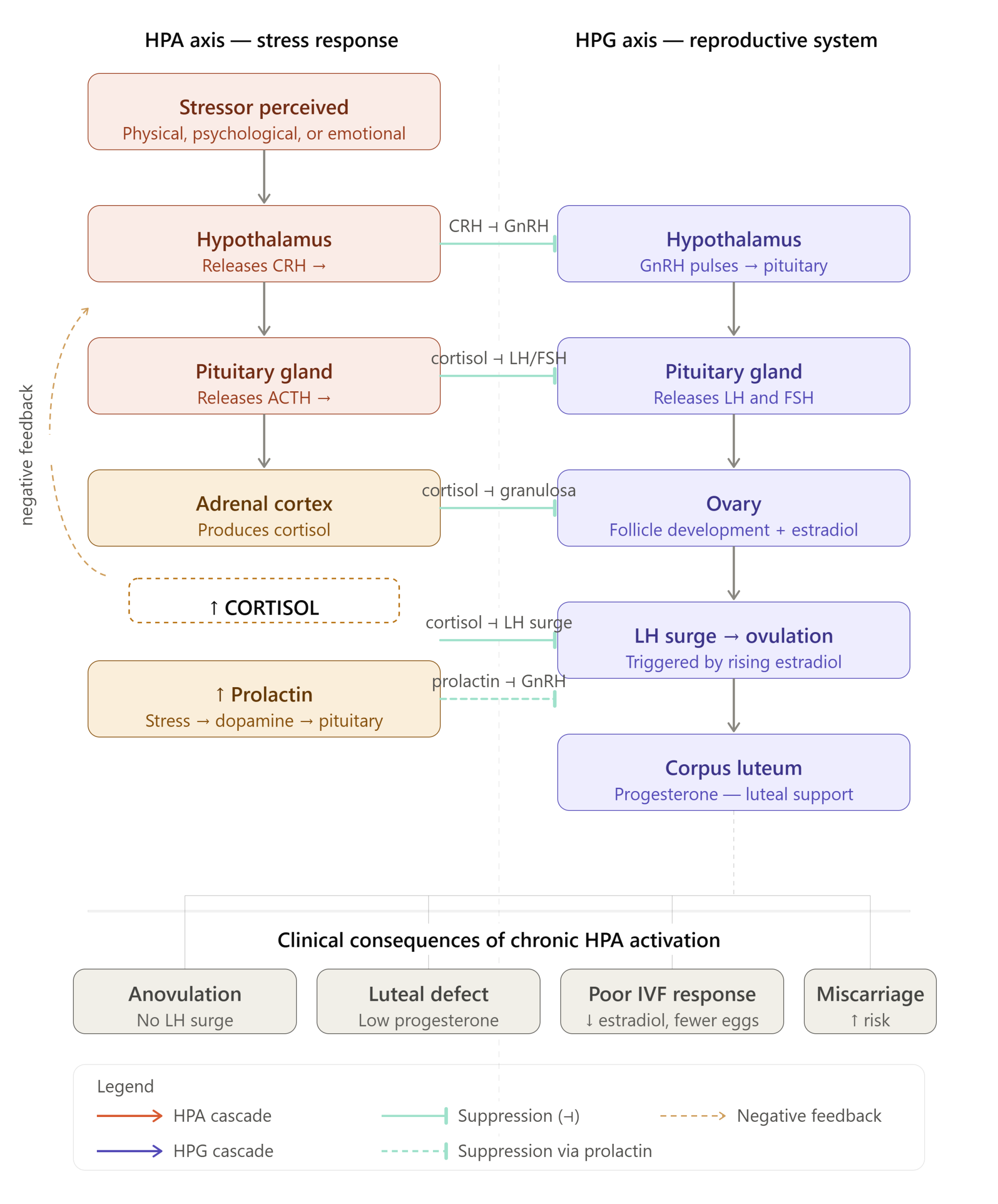
The Stress-Infertility Feedback Loop
One of the most clinically important and least-acknowledged aspects of how stress affects fertility is the feedback loop between them.
Dealing with infertility is profoundly stressful. Studies consistently find that women experiencing infertility have psychological distress scores comparable to women with cancer diagnoses – including elevated anxiety, depression, social isolation, and grief that worsens with each unsuccessful cycle.8 This means that infertility itself generates exactly the kind of sustained psychological stress that affects fertility by activating CRH-mediated GnRH suppression.
The clinical implications are significant: the stress of infertility can physiologically contribute to the hormonal dysregulation that perpetuates it. This is not victim-blaming. It is a mechanistic observation that has clinical management implications. Addressing stress physiology during fertility treatment is not a soft add-on; it is addressing a real physiological variable that affects the outcomes of treatment.
It is equally important to state clearly: stress affects fertility, but it is not the cause of most infertility. Women in acutely stressful life circumstances conceive every day. The stress-GnRH pathway produces its greatest reproductive effects in women who are already at the margins of normal reproductive function – where borderline LH surge amplitude or marginal luteal progesterone production is tipped into clinical insufficiency by chronic cortisol elevation. For women with clearly structural causes of infertility (blocked tubes, severe PCOS, severe endometriosis, significant male factor), stress management is a supportive measure – not the primary intervention.
What the Evidence Shows About How Stress Affects Fertility and IVF Outcomes
The IVF context provides the best-controlled data on how stress affects fertility outcomes, because cycle outcomes are objectively measured and cycle variables are pharmacologically managed.
A 2011 meta-analysis of 14 studies (2,000+ women) found that emotional distress before and during IVF was associated with significantly lower pregnancy rates – with the association strongest in the follicular phase, consistent with the cortisol-granulosa cell mechanism described above.5
A 2014 prospective study measured salivary alpha-amylase (a marker of sympathoadrenal activation) and found that women in the highest tertile of alpha-amylase had a 29% reduction in fecundity (longer time to pregnancy) compared with those in the lowest tertile.9
A 2019 prospective cohort study of women undergoing natural or stimulated IVF cycles found that higher perceived stress in the follicular phase was associated with lower peak estradiol, fewer mature oocytes retrieved, and lower fertilization rates – consistent with the granulosa cell cortisol mechanism.10
These associations are real and clinically meaningful. They are not strong enough to conclude that stress management alone would dramatically change IVF outcomes for most people – but they are strong enough to conclude that leaving stress physiology entirely unaddressed during an IVF cycle is a missed opportunity.
Stress, Thyroid Autoimmunity, and Fertility: An Underappreciated Connection
Chronic psychological stress alters immune function in ways directly relevant to fertility, beyond the HPA-reproductive axis mechanisms described above.
Stress-induced glucocorticoid exposure initially suppresses immune activity; with chronic stress, immune dysregulation follows – including shifts toward Th2-dominant immune responses and increased inflammatory cytokine production that can trigger or exacerbate autoimmune conditions.11
Autoimmune thyroid disease (Hashimoto’s thyroiditis) is significantly more prevalent in women with infertility and recurrent miscarriage than in the general population. Anti-thyroid antibodies impair endometrial receptivity and increase miscarriage risk independently of TSH. The onset or exacerbation of Hashimoto’s thyroiditis following periods of acute psychological stress is a well-recognized clinical pattern – the stress-immune connection is a plausible contributing mechanism.
This is not a reason to conclude that stress causes thyroid autoimmunity. It is a reason to investigate thyroid antibodies in women with significant chronic stress and unexplained infertility, and to consider that chronic stress affects fertility through altered immune system behaviour as part of the clinical picture.
The Male Side: Stress and Sperm
The fertility conversation around how stress affects fertility is almost entirely focused on women. The evidence on men is equally compelling.
Cortisol directly suppresses testosterone production in the testes by inhibiting Leydig cell function via glucocorticoid receptor-mediated signalling.12 Testosterone is required for spermatogenesis – adequate intratesticular testosterone concentrations are necessary throughout the 74-day sperm production cycle. Chronic cortisol elevation that suppresses intratesticular testosterone can impair sperm production, motility, and morphology even when circulating testosterone remains borderline normal.
The sympathoadrenal arm of the stress response elevates reactive oxygen species (ROS) in seminal plasma, contributing to oxidative stress-driven sperm DNA fragmentation independent of the cortisol pathway. Elevated sperm DNA fragmentation is associated with reduced fertilization rates, early embryo arrest, and increased miscarriage rates, and its oxidative etiology makes it directly addressable through antioxidant intervention and stress reduction in combination.
A 2014 study found that men who experienced two or more stressful life events in the year before providing a semen sample had significantly lower sperm motility and morphology than men who experienced no stressful events – an association that remained after controlling for health behaviours.13
What Actually Helps: Evidence-Based Stress Management for Fertility
The evidence base for stress reduction interventions in the fertility context is more substantial than most people realize – and the interventions with evidence are specific, not generic.
Acupuncture
Acupuncture has the most consistent evidence base of any intervention for reducing acute stress physiology around IVF. The most studied application is peri-transfer acupuncture – sessions on the day before and day of embryo transfer – where the proposed mechanism includes reduced uterine contractility, reduced sympathoadrenal activation, and modulation of endometrial immune cell activity. A 2019 systematic review and meta-analysis found that acupuncture around the time of embryo transfer was associated with improved clinical pregnancy rates compared to sham acupuncture.14
The proposed mechanism for the acute stress reduction effect involves stimulation of peripheral afferent nerves that modulate hypothalamic CRH release – a direct intervention on the same pathway by which stress affects fertility by impairing GnRH pulsatility.
Ashwagandha (Withania somnifera)
KSM-66 ashwagandha root extract is the most studied adaptogenic herb for HPA axis regulation. A double-blind RCT in chronically stressed adults found that 300 mg twice daily significantly reduced serum cortisol (27.9% reduction vs. 7.9% in placebo), perceived stress scale scores, and anxiety over eight weeks.15 The mechanism involves modulation of glucocorticoid receptor sensitivity and reduction of HPA axis reactivity to stressors.
Ashwagandha is appropriate during the fertility preparation phase. It is paused during IVF stimulation, after embryo transfer, and during pregnancy – insufficient safety data exists to use it in these contexts. For women pursuing natural conception, it can be used continuously with monitoring, but stopped in pregnancy.
Mind-Body Interventions
A landmark RCT by Domar et al. found that women who participated in a 10-week mind-body program (combining relaxation response, cognitive restructuring, and group support) had significantly higher pregnancy rates than the control group – 55% vs. 20% in women who had been trying for 1–2 years.16 The effect size is larger than that of most pharmacological fertility interventions, though the study has limitations, including lack of blinding and a specific population.
What’s clinically useful from this research: structured, consistent stress management practice – not generic advice to “relax” but regular practice of specific techniques – produces physiological changes in HPA axis reactivity that are measurable and reproducible in multiple studies. The specific technique matters less than the regularity and the physiological activation (parasympathetic engagement, reduced cortisol reactivity). Options with evidence include: mindfulness-based stress reduction (MBSR), yoga (particularly restorative and parasympathetic-activating styles), cognitive-behavioural therapy (CBT), and fertility-specific group support.
Exercise – the Right Dose
Moderate exercise is one of the most effective interventions for HPA axis regulation available: it improves cortisol clearance, increases cortisol sensitivity (so less cortisol is needed for the same effect), and reduces basal HPA axis activation over time.17 30–45 minutes of moderate-intensity aerobic exercise five days per week is the evidence-supported target.
The important caveat: very high-intensity exercise – particularly chronic high-volume endurance training or CrossFit-style high-intensity interval training at high frequency – is itself a significant HPA axis stressor. Women who are already HPA-dysregulated from psychological stress and then add very high exercise loads are compounding rather than resolving the problem. Elite athletes and women with very high exercise volumes often have hypothalamic amenorrhea as a direct consequence.
Sleep
Cortisol follows a diurnal rhythm with the lowest levels occurring in the first hours of sleep. Disrupted sleep – whether from poor sleep hygiene, shift work, insomnia, or the anxiety of fertility treatment – elevates nocturnal cortisol, blunts the morning cortisol awakening response (CAR), and impairs HPA axis recovery from daily stressors. GnRH pulsatility is synchronized with sleep, and disruption of the circadian rhythm directly impairs the GnRH pulse frequency that drives reproductive hormone cycling.
Seven to nine hours per night with consistent sleep and wake times is not optional in fertility preparation. Melatonin at 0.5–3 mg at bedtime supports sleep onset and circadian rhythm synchronization – and simultaneously provides direct antioxidant protection to the developing oocyte.
Targeted Nutritional Support for HPA Axis Function
The adrenal glands have among the highest concentrations of vitamin C in the body – vitamin C is required for cortisol synthesis, and acute adrenal stress rapidly depletes it. Vitamin C at 500–1000 mg/day supports adrenal function under stress without suppressing cortisol synthesis pathways.
Magnesium has a bidirectional relationship with the stress response: magnesium deficiency increases HPA axis reactivity, and HPA activation increases urinary magnesium excretion, creating a cycle of depletion. Magnesium glycinate at 200–400 mg at bedtime addresses both the deficiency and the sleep disruption that accompany HPA dysregulation.
B vitamins, particularly B5 (pantothenic acid), B6 (P5P), and B12 (methylcobalamin), are cofactors in adrenal steroid synthesis and the methylation pathways that support catecholamine (adrenaline and noradrenaline) clearance. The same methylated B-complex appropriate for fertility preparation addresses this nutritional substrate simultaneously.
What Stress Management Cannot Do
This is the section the internet most frequently omits.
Stress management cannot unblock a fallopian tube. It cannot correct chromosomal aneuploidy in eggs. It cannot reverse premature ovarian insufficiency, but stress affects fertility as a factor that can make it worse. It cannot resolve antiphospholipid syndrome. It cannot improve sperm DNA fragmentation caused by a varicocele. It does not substitute for investigation of the structural, immunological, endocrine, and genetic causes of infertility that require medical diagnosis and management.
For women with clearly treatable causes of infertility, stress management is an adjunct to appropriate medical and naturopathic treatment – not a replacement for it.
For women with unexplained infertility, recurrent implantation failure, or IVF cycles that have not responded as expected despite apparently adequate protocols, addressing stress physiology systematically – as one modifiable variable in a comprehensive optimization approach – is clinically appropriate and evidence-supported.
The goal is not to tell anyone that their infertility is caused by stress or that they would be pregnant if they only managed it better. The goal is to ensure that an identifiable, measurable, physiologically operative variable is not left entirely unaddressed.
Frequently Asked Questions About How Stress Affects Fertility
Can stress alone cause infertility?
Not typically. Stress is a modifiable contributor to hormonal dysregulation – particularly suppression of GnRH pulsatility, blunting of the LH surge, and luteal phase insufficiency – that can compound the effects of other fertility challenges. Women in significant psychological stress conceive regularly. Stress affects fertility more when it is chronic, when it operates alongside other fertility challenges, and particularly in the context of IVF, where the evidence for an effect on ovarian response and implantation is strongest.
Why do people spontaneously conceive on holiday or after stopping fertility treatments?
This observation is real, and the proposed mechanism is plausible: removal of work stress and the acute stress of active fertility treatment – monitoring appointments, timed intercourse demands, two-week waits – may reduce CRH-mediated GnRH suppression and allow the reproductive axis to function more freely. However, selection bias matters here: the women who conceive after stopping treatment are those whose underlying fertility was sufficient to allow natural conception when other conditions aligned. This outcome is not predictable or generalizable.
How do I know if stress is affecting my hormones?
Indirect markers include: long or irregular cycles, anovulatory cycles confirmed on basal body temperature charting or LH monitoring, short luteal phase (less than 12 days), low 7-day post-ovulation progesterone (below 40 nmol/L), elevated prolactin on properly drawn labs, or poor ovarian response to IVF stimulation. These findings warrant investigation of their causes – stress is one possible contributor among several that should be systematically evaluated.
Cortisol can be measured through various means – blood, saliva, and a 24-hour urine sample. Rather than assuming it is high, I will often order an early morning blood cortisol level as an initial screen.
Should I stop fertility treatments if I’m feeling very stressed?
Not necessarily. The evidence does not support treatment breaks as a universal stress management strategy. What it supports is active management of stress physiology during treatment – through acupuncture, structured mind-body practice, appropriate exercise, sleep optimization, and nutritional support – rather than passive endurance of an acutely stressful process.
Is the “just relax” advice harmful?
Yes, often. It implies that the person’s stress is causing their infertility – adding guilt and self-blame to an already difficult situation. It also redirects from the real clinical work of investigating and treating ALL of the underlying causes. What is accurate is that chronic stress physiology is a modifiable variable worth addressing systematically, alongside – not instead of – thorough investigation of the structural, endocrine, immune, and genetic factors that are more commonly the primary drivers of infertility.
How Stress Affects Fertility: Research References
- Joseph DN, Whirledge S. Stress and the HPA Axis: Balancing Homeostasis and Fertility. Int J Mol Sci. 2017 Oct 24;18(10):2224. doi: 10.3390/ijms18102224. PMID: 29064426; PMCID: PMC5666903.
- Oakley AE, Clifton DK, Steiner RA. Kisspeptin signalling in the brain. Endocr Rev. 2009 Oct;30(6):713-43. doi: 10.1210/er.2009-0005. Epub 2009 Sep 21. PMID: 19770291; PMCID: PMC2761114.
- Breen KM, Karsch FJ. Does cortisol inhibit pulsatile luteinizing hormone secretion at the hypothalamic or pituitary level? Endocrinology. 2004 Feb;145(2):692-8. doi: 10.1210/en.2003-1114. Epub 2003 Oct 23. PMID: 14576178.
- Whirledge S, Cidlowski JA. Glucocorticoids, stress, and fertility. Minerva Endocrinol. 2010 Jun;35(2):109-25. PMID: 20595939; PMCID: PMC3547681.
- Matthiesen SM, Frederiksen Y, Ingerslev HJ, Zachariae R. Stress, distress and outcome of assisted reproductive technology (ART): a meta-analysis. Hum Reprod. 2011 Oct;26(10):2763-76. doi: 10.1093/humrep/der246. Epub 2011 Aug 1. PMID: 21807816.
- Henley DV, Korach KS. Physiological effects and mechanisms of action of endocrine disrupting chemicals that alter estrogen signaling. Hormones (Athens). 2010 Jul-Sep;9(3):191-205. doi: 10.14310/horm.2002.1270. PMID: 20688617; PMCID: PMC4782146.
- Sonigo C, Bouilly J, Carré N, Tolle V, Caraty A, Tello J, Simony-Conesa FJ, Millar R, Young J, Binart N. Hyperprolactinemia-induced ovarian acyclicity is reversed by kisspeptin administration. J Clin Invest. 2012 Oct;122(10):3791-5. doi: 10.1172/JCI63937. Epub 2012 Sep 24. PMID: 23006326; PMCID: PMC3461919.
- Domar AD, Zuttermeister PC, Friedman R. The psychological impact of infertility: a comparison with patients with other medical conditions. J Psychosom Obstet Gynaecol. 1993;14 Suppl:45-52. PMID: 8142988.
- C.D. Lynch, R. Sundaram, J.M. Maisog, A.M. Sweeney, G.M. Buck Louis, Preconception stress increases the risk of infertility: results from a couple-based prospective cohort study—the LIFE study, Human Reproduction, Volume 29, Issue 5, May 2014, Pages 1067-1075, https://doi.org/10.1093/humrep/deu032
- Zhou, F. Jing, Cai, Y. Na, & Dong, Y. Zhi. (2019). Stress increases the risk of pregnancy failure in couples undergoing IVF. Stress, 22(4), 414–420. https://doi.org/10.1080/10253890.2019.1584181
- Dhabhar FS. Effects of stress on immune function: the good, the bad, and the beautiful. Immunol Res. 2014 May;58(2-3):193-210. doi: 10.1007/s12026-014-8517-0. PMID: 24798553.
- Whirledge S, Cidlowski JA. Glucocorticoids, stress, and fertility. Minerva Endocrinol. 2010 Jun;35(2):109-25. PMID: 20595939; PMCID: PMC3547681.
- Nordkap L, Jensen TK, Hansen ÅM, Lassen TH, Bang AK, Joensen UN, Blomberg Jensen M, Skakkebæk NE, Jørgensen N. Psychological stress and testicular function: a cross-sectional study of 1,215 Danish men. Fertil Steril. 2016 Jan;105(1):174-87.e1-2. doi: 10.1016/j.fertnstert.2015.09.016. Epub 2015 Oct 23. PMID: 26477499.
- Smith CA, Armour M, Shewamene Z, Tan HY, Norman RJ, Johnson NP. Acupuncture performed around the time of embryo transfer: a systematic review and meta-analysis. Reprod Biomed Online. 2019 Mar;38(3):364-379. doi: 10.1016/j.rbmo.2018.12.038. Epub 2019 Jan 2. PMID: 30658892.
- Chandrasekhar K, Kapoor J, Anishetty S. A prospective, randomized double-blind, placebo-controlled study of safety and efficacy of a high-concentration full-spectrum extract of ashwagandha root in reducing stress and anxiety in adults. Indian J Psychol Med. 2012 Jul;34(3):255-62. doi: 10.4103/0253-7176.106022. PMID: 23439798; PMCID: PMC3573577.
- Domar AD, Clapp D, Slawsby EA, Dusek J, Kessel B, Freizinger M. Impact of group psychological interventions on pregnancy rates in infertile women. Fertil Steril. 2000 Apr;73(4):805-11. doi: 10.1016/s0015-0282(99)00493-8. Erratum in: Fertil Steril 2000 Jul;74(1):190. PMID: 10731544.
- Silverman MN, Deuster PA. Biological mechanisms underlying the role of physical fitness in health and resilience. Interface Focus. 2014 Oct 6;4(5):20140040. doi: 10.1098/rsfs.2014.0040. PMID: 25285199; PMCID: PMC4142018.
