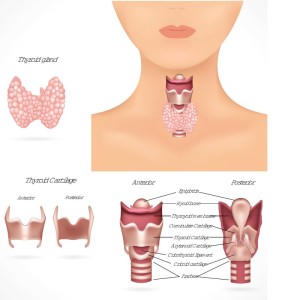
Thyroid Problems
Problems with this gland are one of the more common reasons for infertility. These issues generally fall into three main categories: an overactive state, which can speed up metabolism and disrupt hormonal balance (as seen in conditions like Graves’ disease); an underactive state, which can slow down many body functions and interfere with ovulation; or an autoimmune condition such as Hashimoto’s disease, where the body’s immune system attacks the gland itself. I use different treatment strategies depending on the type and underlying cause of the dysfunction, tailoring care to restore proper hormonal regulation and support reproductive health.
Hyperthyroid or Graves’ Disease
What is Graves’ Disease?
Graves’ disease is an autoimmune disorder that results in elevated levels of circulating free T3 and free T4.
What are the Symptoms of Graves’ Disease?
The symptoms of Graves’ disease include nervousness/anxiety, insomnia, heat intolerance, heart palpitations, and unexplained weight loss.
What Causes Graves’ Disease?
As with any autoimmune disorder, there is overactivity of the immune system. Possible triggers for this hyperactivity of the immune system include latent or low-grade infections, food sensitivities, Celiac Disease, poor gut health, and vitamin/mineral imbalances.
Naturopathic Treatment of Graves’ Disease
To treat Graves’ disease, we want to balance immune system function by addressing bacterial/viral/fungal infections, testing for and removing food sensitivities from the diet, restoring good bacteria to the gut, and correcting any vitamin or mineral deficiencies or excesses.
Hypothyroidism
Being hypothyroid means that this important gland is underactive or sluggish. It’s not producing enough of the hormones your body needs to function at its best. These hormones play a critical role in regulating the activity of every tissue and cell, influencing everything from metabolism and energy levels to the balance of other hormones. When this gland isn’t functioning properly, it can have a ripple effect throughout the entire body, especially on your reproductive system. Your ovaries, adrenal glands, and even the pituitary can all be affected, making it harder to ovulate regularly or maintain a healthy pregnancy.
What are the Symptoms of Hypothyroidism?
When this gland is underactive, it can lead to a wide range of symptoms that often affect multiple systems in the body. Common signs include unexplained weight gain, feeling unusually cold even in warm environments, and a general sense of mental sluggishness or brain fog. Many people also experience hair thinning or hair loss, dry or coarse hair, and dry or rough skin. Reproductive health may be impacted as well, with symptoms such as irregular menstrual cycles, difficulty conceiving, or recurrent miscarriages.
Other common complaints include persistent fatigue, low energy levels that don’t improve with rest, muscle weakness, and an overall feeling of being run down. These symptoms can develop gradually, making them easy to overlook or attribute to stress, aging, or other causes.
What Causes Hypothyroidism?
Good question! If this gland isn’t working properly, the most obvious reason may be a lack of essential vitamins and minerals. This gland needs iodine, selenium, copper, and tyrosine to function properly. Deficiencies of iodine, iron, selenium, and zinc may impair its function. Other nutrient deficiencies commonly observed in patients with this gland disease include protein deficiencies; vitamin A, C, B6, B5, and B1 deficiencies; and mineral deficiencies (phosphorus, magnesium, potassium, sodium, and chromium). DO NOT supplement with iodine without a naturopathic doctor’s supervision. Too much iodine can induce nodules and/or induce or aggravate Graves’ disease. While these deficiencies do sometimes occur, the more common cause of hypothyroidism is an autoimmune condition called Hashimoto’s disease.
Naturopathic Treatment for Hypothyroidism
As a naturopathic doctor treating hypothyroidism, I would address any possible vitamin/mineral deficiencies, order blood work to determine whether there is Hashimoto’s disease, and support the rest of your endocrine system.
Hashimoto’s Disease
Hashimoto’s is an autoimmune disease where your body attacks and destroys the tissue of this vital gland. Many of the patients that I see who are hypothyroid have undiagnosed Hashimoto’s. Medical doctors rarely test for Hashimoto’s because the test results don’t influence the prescribed medication. Naturopathically, treatment does change when the gland is underactive due to Hashimoto’s. The emphasis of treatment then shifts to an approach similar to that for Graves’ disease: address all factors that may have overstimulated the immune system, causing it to attack a vital gland.
How do you test the thyroid?
The standard blood test for this gland is TSH, which stands for Thyroid-Stimulating Hormone. This hormone is produced by your pituitary to stimulate the gland to produce its hormone, called T4 (thyroxine). T4 is then converted to T3, which is the more active form of the hormone.
The normal range for TSH is 0.35-5.00 mIU/L. In infertility, TSH, free T3, reverse T3, and free T4 should be measured, as well as screening for anti-thyroid antibodies, including anti-TPO and anti-thyroglobulin. In infertile women with baseline TSH levels of 2.5 to 5.0 mIU/L, a TRH stimulation test should also be done to detect subclinical disease that may require treatment to improve pregnancy outcomes. I can order some of these tests. If they haven’t been done, they should be.
References
Guastamacchia E. Selenium and Iodine in Autoimmune Thyroiditis. Endocr Metab Immune Disord Drug Targets. 2015 Jun 18.
Degirmenci PB, Kirmaz C, Oz D, Bilgir F, Ozmen B, Degirmenci M, Colak H, Yilmaz H, Ozyurt B. Allergic rhinitis and its relationship with autoimmune thyroiod diseases. Am J Rhinol Allergy. 2015 Jun 10.
Merrill SJ, Mu Y. Thyroid autoimmunity as a window to autoimmunity: An explanation for sex differences in the prevalence of thyroid autoimmunity. J Theor Biol. 2015 Jun 21;375:95-100. doi: 10.1016/j.jtbi.2014.12.015. Epub 2015 Jan 6.
Okosieme O, Gilbert J, Abraham P, Boelaert K, Dayan C, Gurnell M, Leese G, McCabe C, Perros P, Smith V, Williams G, Vanderpump M. Management of Primary Hypothyroidism Statement by the British Thyroid Association Executive Committee. Clin Endocrinol (Oxf). 2015 May 23. doi: 10.1111/cen.12824. [Epub ahead of print]
Kawicka A, Regulska-Ilow B, Regulska-Ilow B. Metabolic disorders and nutritional status in autoimmune thyroid diseases. Postepy Hig Med Dosw (Online). 2015 Jan 2;69:80-90. doi: 10.5604/17322693.1136383.
Lee YJ, Kim CH, Kwack JY, Ahn JW, Kim SH, Chae HD, Kang BM. Subclinical hypothyroidism diagnosed by thyrotropin-releasing hormone stimulation test in infertile women with basal thyroid-stimulating hormone levels of 2.5 to 5.0 mIU/L. Obstet Gynecol Sci. 2014 Nov;57(6):507-12. doi: 10.5468/ogs.2014.57.6.507. Epub 2014 Nov 20.